Autism spectrum disorder (ASD) is a neurodevelopmental condition characterized by differences in social communication, behavior, and sensory processing. While the exact causes are complex and involve genetic and environmental factors, research has identified various biochemical differences including altered serotonin function in some individuals with ASD. The Serotonin, Serum test is the most important biochemical marker test for autism-related research, as elevated serotonin levels have been reported in approximately 25-30% of individuals with autism.
90-day money-back guaranteeLab order in minutesSave a trip to the doctorLow prices since 2005Labs within 2 miles
What causes autism spectrum disorder?
Autism spectrum disorder is caused by a combination of genetic and environmental factors that affect brain development. Research suggests that multiple genes contribute to autism risk, and these genetic variations can affect how brain cells communicate and develop. Environmental factors during pregnancy and early development, such as parental age, prenatal exposure to certain medications, and complications during birth, may also play a role. Additionally, some individuals with autism show biochemical differences including altered serotonin metabolism, immune system irregularities, and mitochondrial dysfunction, though these are not present in all cases.
What is the best test for autism spectrum disorder?
The Serotonin, Serum test is the most important biochemical marker test for autism because it detects elevated serotonin levels found in approximately 25-30% of individuals with ASD. This test measures blood serotonin concentrations, which research has shown to be significantly higher in some people with autism compared to the general population. While blood tests cannot diagnose autism itself, the Serotonin, Serum test provides valuable insights into the biochemical factors associated with the condition. Autism diagnosis requires comprehensive developmental and behavioral assessments by qualified healthcare professionals, typically including standardized screening tools, clinical observation, and detailed developmental history. Laboratory testing like serotonin measurement serves as a complementary tool for understanding the biological aspects of autism and supporting personalized care approaches.
When should I get tested for autism-related biochemical markers?
You should get tested if you or your child has already received an autism diagnosis and you want to understand potential biochemical factors that may be associated with the condition. Testing may also be valuable if you are working with a healthcare provider on comprehensive care strategies and want to investigate biological markers like serotonin levels. Additionally, consider testing if you are participating in autism research studies or if your healthcare provider recommends biochemical screening as part of a holistic assessment. Remember that these blood tests are supplementary tools and do not replace the standard behavioral and developmental assessments used to diagnose autism spectrum disorder.
What are the symptoms of autism spectrum disorder?
Autism spectrum disorder symptoms typically appear in early childhood and vary widely in severity. Common signs include difficulty with social communication such as limited eye contact, trouble understanding social cues, and challenges in forming relationships. Many individuals with autism display repetitive behaviors like hand-flapping, rocking, or strict adherence to routines, and may become upset by changes in their environment. Sensory sensitivities are common, with some people being over-responsive or under-responsive to sounds, lights, textures, or smells. Speech and language development may be delayed, and some individuals are nonverbal or have difficulty with conversational skills. Intense focus on specific interests and difficulty with imaginative play are also characteristic features of autism.
Who is at risk for autism spectrum disorder?
Certain factors increase the risk of autism spectrum disorder, though it can occur in any family. Siblings of children with autism have a higher risk, with studies showing about 10-20% chance of also having ASD. Boys are approximately four times more likely to be diagnosed with autism than girls. Children born to older parents, particularly fathers over 40, have slightly increased risk. Premature babies, especially those born before 26 weeks of gestation, and children with certain genetic conditions like Fragile X syndrome or tuberous sclerosis have elevated autism risk. Having a parent or sibling with autism or other neurodevelopmental conditions also increases likelihood, though most children with autism have no family history of the disorder.
What happens if autism is not identified early?
When autism spectrum disorder is not identified and addressed early, individuals may miss critical opportunities for early intervention during the most formative developmental years. Without appropriate support, children with undiagnosed autism often struggle significantly in school, experiencing academic difficulties and social isolation that can lead to anxiety, depression, and low self-esteem. Communication challenges may persist and worsen, making it harder to form relationships and navigate daily life. Behavioral issues can intensify without proper strategies and support systems in place. As adults, individuals with undiagnosed autism may face employment difficulties, relationship challenges, and mental health problems. Early identification and intervention are associated with significantly better long-term outcomes, improved social skills, enhanced communication abilities, and greater independence.
Can autism be diagnosed with a blood test?
Autism spectrum disorder cannot be diagnosed with a blood test alone. ASD is diagnosed through comprehensive behavioral assessments, developmental screenings, and detailed evaluation of social communication and behavior patterns by trained healthcare professionals. However, blood tests like the Serotonin, Serum test can provide valuable supplementary information about biochemical factors that may be associated with autism. These laboratory tests help identify biological markers such as elevated serotonin levels, which are found in some individuals with autism, and can support research efforts and personalized care approaches. While blood work does not replace the standard diagnostic process, it offers insights into the underlying biology that may contribute to autism symptoms and can guide comprehensive treatment planning.
How is autism spectrum disorder treated?
Autism spectrum disorder is managed through individualized interventions that address each person's unique strengths and challenges. Applied Behavior Analysis (ABA) therapy is widely used to improve social, communication, and learning skills through structured, evidence-based techniques. Speech and language therapy helps develop communication abilities, while occupational therapy addresses sensory sensitivities and daily living skills. Social skills training supports relationship-building and understanding social cues. Many individuals benefit from educational interventions through special education programs with individualized education plans (IEPs). Medications may be prescribed to manage co-occurring conditions like anxiety, depression, ADHD, or seizures, though no medication treats autism itself. Early intervention programs for young children have shown the best outcomes, and comprehensive treatment plans typically involve a team of specialists working together with family members.
How can autism spectrum disorder be prevented?
Autism spectrum disorder cannot be prevented because it results from complex interactions between genetic and environmental factors that are not fully understood or controllable. However, certain prenatal practices may support healthy fetal brain development and potentially reduce risk. Taking prenatal vitamins with folic acid before conception and during pregnancy supports neural development. Avoiding alcohol, tobacco, and illicit drugs during pregnancy is important, as is managing chronic health conditions and avoiding unnecessary medication exposure. Seeking early and regular prenatal care helps identify and address complications promptly. While these practices promote overall healthy pregnancy outcomes, they do not guarantee prevention of autism. Focus should be on early screening and intervention if developmental concerns arise, as early support dramatically improves long-term outcomes for children with autism.
What can I do at home to support someone with autism?
Supporting someone with autism at home involves creating a structured, predictable environment that reduces anxiety and promotes success. Establish consistent daily routines and use visual schedules to help the person understand what to expect throughout the day. Create a calm, sensory-friendly space where they can retreat when overwhelmed, considering lighting, noise levels, and comfortable textures. Use clear, direct communication with simple instructions and allow extra processing time for responses. Encourage special interests as these can be sources of joy and potential pathways for learning and social connection. Practice patience during meltdowns and learn individual triggers to help prevent them. Celebrate small successes and focus on strengths rather than deficits. Connect with autism support communities for practical strategies and emotional support, and maintain open communication with therapists and educators to ensure consistency across environments.
How’s this work?
Getting your blood test with us is easy, private & backed by the power of science.
Long story short:
In the test options, use the filters or search box to narrow your choices and find the test you want.
If you need a hand navigating through options, text our super friendly support team at 754-799-7833, and we'll provide tailored suggestions to help you find the ideal test.
Once your order is placed, we’ll create your doctor’s lab order remotely, without any need for you to make a trip to a doctor in person or to talk to the doctor. Expect to receive your doctor’s lab order right in your inbox. It will also be in your patient portal if you need to find it later. We’ll also include instructions regarding fasting and other requirements for your test. Your patient portal will be auto-created hassle-free during checkout.
If this is your first time ordering, you'll be prompted to create a password for instant login access to your patient portal. It's a quick way to conveniently access your orders and results whenever you want.
When you’re ready, visit one of our 4,000 locations. Just bring your ID – no printing or faxing of your lab order is needed, as your order and details will already be in the lab system.
Note that most lab locations don’t accept walk-ins, so it’s best to book an appointment in advance. Don’t worry – we’ll provide detailed instructions along the way.
You’ll get your results via email & SMS and dive into understanding your body better. Yup, that easy!
If you have any questions, please text us at 754-799-7833 or email support@privatemdlabs.com and we'll gladly help you.
How do I know which test to get?
In the test options, find the test you want.
If you’re not sure which test to get, we can lend a hand in finding the right option.
Just text or call us at 754-799-7833, email us at support@privatemdlabs.com, and we'll gladly help you. We've got your back and reply quickly.
Is it possible to make changes to my lab order if I made a mistake with the name, date of birth, or any other details?
Absolutely! We totally understand that errors can happen. No worries, we're here to help you.
Just reach out to us via text at 754-799-7833 or shoot us an email at
support@privatemdlabs.com. Remember to include your order number and let us know the correct information you’d like to update.
Our awesome team will jump right in and make sure everything is sorted out and accurate for you.
There are no changes necessary if your address is wrong on the requisition though. We don’t mail anything out.
Our lab requires an address to be listed to generate an order.
Do you accept health insurance?
Only HSA & FSA is accepted.
Our services are strictly self-pay and cannot be submitted to your health insurance provider except for Health Savings Accounts or Flexible Savings Accounts.
This policy applies to all insurance companies, including federal health insurance programs like Medicare.
You can read more about our cancellation policy here.
How can I find a lab location near me?
During the ordering process, you’ll be able to select a specific lab near you, with no strings attached!
You can switch it up later easily and visit any of our authorized locations as long as it’s the same lab company you selected your test for (Quest Diagnostics or Labcorp).
Before you proceed with your order, feel free to browse through all our lab locations here. This will give you the peace of mind of knowing that there's a lab nearby your home, office or your favorite gym.
Here’s how easy it is to get blood work done on your terms
Order your testSave a trip to the doctor. Your results will come with clear, friendly explanations.Takes 2 minutes
Book an appointmentVisit any of our 4,000 nearby lab locations to have your samples collected.Book or walk-in
Get resultsReceive a clear, easy-to-digest health report by email & SMS within a few business days.Get answers, fast
Here’s why 1,000,000+ customers chose us for affordable hassle-free private blood testing.
You get clinical lab reports & simplified health insights.
Save time & gas, go straight to the lab. Our doctors cover the rest.
Results start landing the next day after your lab visit.*
We don’t sell or share your data. Your time & privacy matter.
US-licensed doctors have your back if things get unclear.
No hidden fees, nice discounts for regular checkups.
Save a trip to the doctor, go directly to the lab
Instant orders, results often overnight*
Results explained in simple language
Reviewed by US licensed doctors
Fast & confidential, we never sell or share your data
No insurance needed, transparent pricing
Demo results
Testosterone375 ng/dL
Demo results
NormalOptimal 400 - 1000High
375 ng/dL
What this means
Your testosterone levels are slightly below the optimal range. While this is not necessarily cause for concern, it may contribute to occasional fatigue, reduced motivation, or lower muscle mass over time.
Recommended actions
Increase resistance or strength training
Prioritize 7–8 hours of quality sleep per night, try to reduce stress
Include more zinc- and magnesium-rich foods (like shellfish, beef, pumpkin seeds, spinach)
Consider retesting in 3–6 months
* Regular blood test results (e.g., CBC) typically start arriving the next business day after sample collection. More complex tests, such as hormone panels, may take up to 10–15 business days due to their complexity.
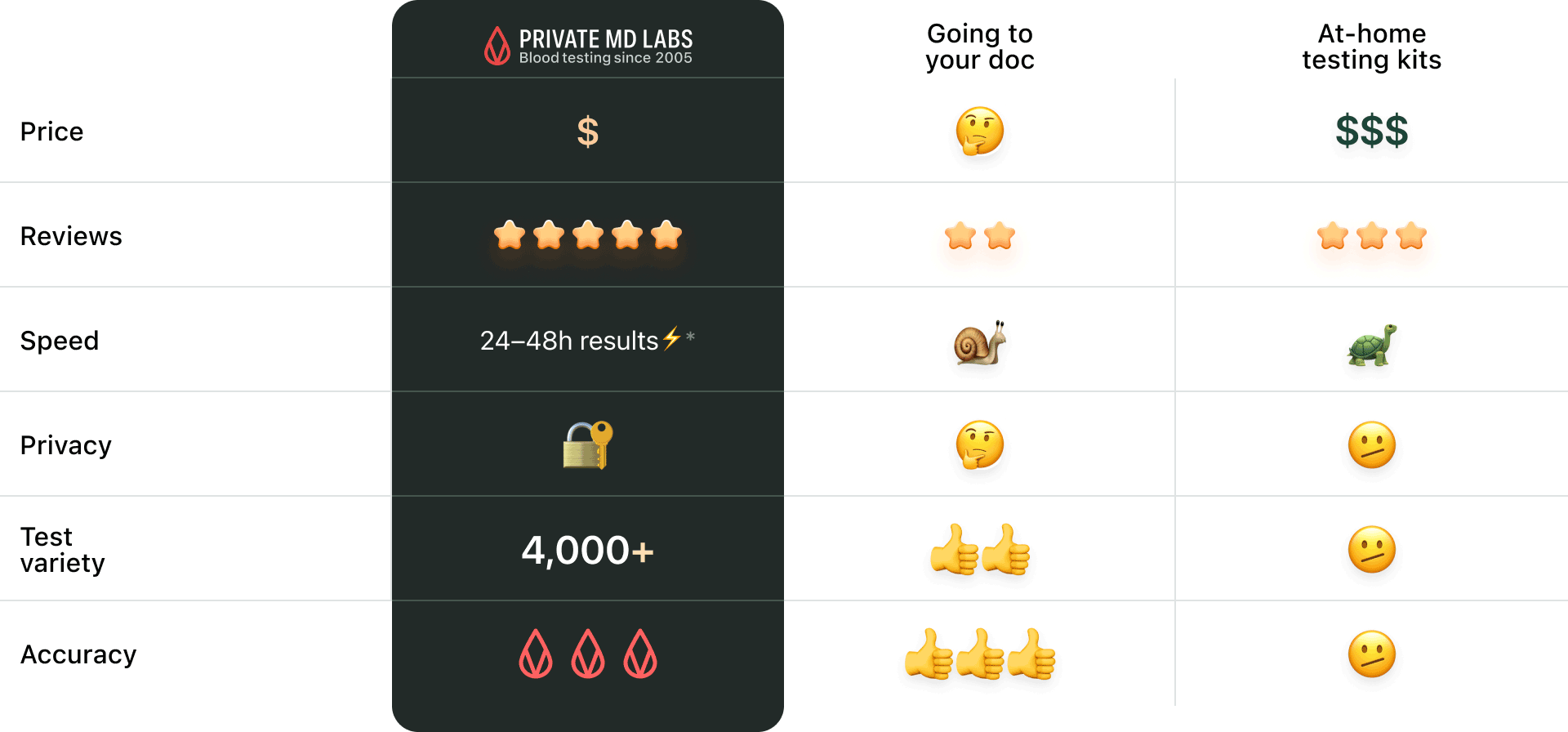
Us vs. Them
Not overhyped or overpriced. Just comprehensive blood testing made simple and for everyone.
* Regular blood test results (e.g., CBC) typically start arriving the next business day after sample collection. More complex tests, such as hormone panels, may take up to 10–15 business days due to their complexity.
1,000,000+ blood tests later, here's what our customers say
Estradiol Ultrasensitive results may get delayed due to high lab volume.It’s a nationwide delay affecting all labs (not just us). Standard processing times apply to all other tests in this panel.
Zinc extended turnaround
Zinc results may get delayed due to high lab volume.It’s a nationwide delay affecting all labs (not just us). Standard processing times apply to all other tests in this panel.
Pregnenolone extended turnaround
Pregnenolone results may get delayed due to high lab volume.It’s a nationwide delay affecting all labs (not just us). Standard processing times apply to all other tests in this panel.
Hi, I'm here to make labs simple, clear, and stress-free. Not sure where to start? That's okay. Tell me what's going on and I'll guide you from there.
I can help you:
choose the right test
prepare for your lab visit
take the next step with confidence and more
Just now
A
Not finding what you need? Text 754-799-7833, we've got you.
We provide helpful guidance, not medical diagnoses. For medical decisions, consult a licensed professional.



 90-day money-back guarantee
 Lab order in minutes
 Save a trip to the doctor
 Low prices since 2005
 Labs within 2 miles